
|
| Amateur
Radio |
Amazon.com |Biology | Books
|
Chemistry | Data
Sheets | Electronics
| Math | Microscope
| NASA-TV
| |
CHEMISTRY - - Page 2 of 3 pages
PAGE 1 INDEX: i. Chemistry Books 1. Introduction 2. Matter 3. Elements 4. Laws & Theories 5. Combinations of Elements
PAGE 2 INDEX: 6. Applied Chemistry 7. Study Online 8. Math for Chemistry 9. Naming Inorganic Compounds 10. Computer Based Laboratory 11. Safety First 12. Start Learning 13. Ph Indicators Chart 14. Chemistry Terms 15. Spectroscopy 16. Chemistry LINKS-1 17. Chemistry Links-2
VERY IMPORTANT!!
Use you browser's "Find on this page" capability
to search for words this page.
Usually Ctrl + F will work.
6. APPLY CHEMISTRY TO EVERYDAY LIFE: The study of science as a mental exercise is not very useful. Applying science knowledge to practical everyday problems is the main purpose in studying any science; chemistry, physics, biology, or mathematics; for example. Discover how chemicals are used in industry, medicine, farming and in the home through the study of applied chemistry - http://www.my-edu2.com/ Start looking at labels of common household chemicals to see what they contain. As you become familiar with the elements and their combinations you will recognize the chemical names that may seem strange sounding at first. Learn about various occupations that require a knowledge of chemistry. Would chemistry be important to pharmacists, physicians, nurses, farmers, product developers, etc.? Why?
Javascript
Page Test
International Union of Pure and Applied Chemistry
IUPAC
Nomenclature Home Page
Kluwer
Academic Publishers - Russian Journal of Applied Chemistry
Curtin
Department of Applied Chemistry Home Page
Please
go to http://www.rmit.edu.au/appchem
Dekker.com
- JOURNAL OF MACROMOLECULAR SCIENCE®, Part A—Pure Pure
& Applied Chemistry @ the University of Strathclyde
1. Introduction 2. Matter 3. Elements 4. Laws & Theories 5. Combinations of Elements
Study these topics then write a paper in your own words on each one to document you studies and findings. Include graphs and diagrams when necessary to aid in the explanation of the topics. That is what learning is all about. Your papers will be a valuable resource later.8. MATHEMATICS FOR CHEMISTRY
- Mathematics is important to all the sciences. A working knowledge of the metric system is a must. Basic math skills to include algebra and some trigonometry will be most helpful. You can obtain a basic understanding of chemistry without mathematics but serious work demands it. Later the calculus will enable you to understand complicated processes and express them in terms understandable to any scientist. Mathematics may seem hard at first but as you study it over time you will find it enjoyable as you learn how it can make complicated issues easy to understand. See our mathematics section. Also see Math Resources for Chemistry - (http://learn.chem.vt.edu/user/long/chemath/chemath.html) . Additional information is available HERE - (http://tqd.advanced.org/2923/baxic/html . Also check out our list of calculators for sale. Texas Instruments handheld calculators connected to a CBL interface can collect laboratory data for further manipulation or transfer to a desktop computer. The CBL kit Includes 3 probes: temperature, light, and voltage. There are five channels for data collection to Measure motion, temperature, light, pH, force, EKG, dissolved oxygen, and more with appropriate probes. Also, impact resistant carrying/storage case, comprehensive guidebook, and a workbook with 21 experiments/activities for math, physics, and chemistry.Dimensional Analysis, Units, Significant Figures, Scientific Notation, Accuracy and Precision, Ratio and Proportion, Graphing, Graphing Calculators, Spreadsheets, Prealgebra, Algebra, Miscellaneous
Significant Numbers - Audio - http://www.accd.edu/nvc/areas/chem/Audio/Lessonettes/SigFigs.mov
Laboratory Math - Solutions/dilutions/Molar, etc .Lab arithmetic, unit conversions, calibration curves
Texas Instruments TI89 Advanced Graphing Calculator
For more information on this unique capability; click HERE -
(www.ti.com).
Laboratory simulation software allows a very safe way to experience chemistry
laboratory procedures on a computer.
Texas
Instruments TI92 Plus Graphing Calculator
The
TI-92 is the best scientific calculator available today!
Download a free evaluation copy of "ChemLab" HERE - (http://modelscience.com)
Link: http://www.fordhamprep.org/gcurran/sho/sho/lessons/lesson54.htm
Link: http://www.geocities.com/CapeCanaveral/Lab/1643/namecompounds.html
Naming
of Inorganic Compounds
Naming
Inorganic Compounds
Naming
Inorganic Compounds
nomen.htm
Rules
for Naming Inorganic Compounds
Rules
for naming inorganic compounds
Naming
Inorganic Compounds
Nomenclature
Naming
Inorganic Compounds
Rules
for Naming Inorganic Compounds
Naming
Inorganic Compounds
Rules
for naming inorganic compounds
Naming
Inorganic Compounds - ticalc.org
Formula
writing
IUPAC
nomenclature of inorganic chemistry - Wikipedia, the free
[PDF] CHEM
177 Naming Compounds 1 Naming Inorganic Compounds 1. metal
Naming
Inorganic Compounds
[PPT] Experiment
3 Nomenclature of Compounds
Inorganic
Chemistry - Pathfinder
[PDF] Flow
Chart for Naming Simple Inorganic Compounds The flowchart is
[PDF] The
Modern View of Atomic Structure The Modern View of Atomic
Names of
common acids and their salts follow these simple rules:
-ic acids form -ate salts - for example sulfuric acid forms sulfate
salts.
-ous acids form -ite salts - for example sulfurous acid forms sulfite salts.
hydro-(stem)-ic acids form -ide salts - for example hydrochloric acid forms
chloride salts.
Features
- CBL
CELL
RESPIRATION - A COMPUTER BASED LABORATORY
Computer-Based
Technology and Learning
Computer-based
Laboratory
Computer-Based
Laboratory
DEVELOPMENT
OF INTERNET-BASED LABORATORY MATERIALS: PHASE II ...
JUG:010A
Computer Based Laboratory
Hazards
Control Computer Assisted Instruction for External ...
Effects
of Computer-based Laboratory Ins... (Abstract) [AACE ...
11. SAFETY FIRST - Chemistry experiments should be done in a controlled, carefully supervised environment such as a school lab (laboratory) or learning center lab unless specifically designed to be safe as a home experiment. Children must be constantly supervised by informed responsible adults educated in lab safety. Never work alone. If you plan on doing any experiments of any kind, pay particular attention to all cautions regarding safety. Have a good fire extinguisher charged and accessible at all times, have everyone in the lab including yourself wear a certified lab apron, protective gloves, safety goggles, and keep plenty of water and paper towels handy for clean up. Keep your work area neat and clean at all times. Know and post your local fire, police, ambulance, and poison control phone numbers. Keep a detailed and dated lab notebook of all your activities. Chemicals and even simple lab procedures can become dangerous quickly. Make safety considerations a first priority. If you are concerned with the safety of an experiment, don't do it. If you are not sure of the outcome of an experiment, don't perform it. Dispose of all chemicals properly. If you don't know the proper chemical disposal procedure, ask the lab supervisor or don't do the experiment. Be careful and always know what the experiments expected results will be. You don't want any unexpected surprises. Remember the object of your effort is to observe our wonderful physical and chemical world, learn more about how complicated it is, how it works, and to wonder why. Not sure? Then be safe and don't experiment physically; do them mentally or with computer simulation software. Don't take any risks.
Laboratory
Safety Guideline
Online Safety Course
The Laboratory Safety Institute Lab Safety Video Rental Training
HHMI
Office of Laboratory Safety
The
Howe High School Science Lab
The
science curriculum has moved
Laboratory
and Chemical Safety
OSU
Laboratory Safety Manual
High
School Lab Safety Credits Page
Lab
Safety
12.
START YOUR LEARNING
-
[PDF] HOW TO SCORE 90%+ IN CHEMISTRY
Thoughts on How to Learn Chemistry
Key2Understanding's Chemistry Zone - the place to learn chemistry
Chemistry and You : learn chemistry
ThinkQuest : Library : Chemistry
Vol 14: Learning Chemistry through Design and Construction (Article)
Chemistry Merit Program, Department of Chemistry
Systemic Approach In Teaching and Learning Chemistry For 21st Century
Distance Learning - Chemistry Distance Education - Online
ELUSIVE PARTICLE FOUND / Antineutrinos may help scientists learn
Chemistry and You : chemistry educational resources
Lesson 1-1 An Introduction to Chemistry
Virginia Tech Chemistry Learning Center
7 July 2005: Learn chemistry, fight malaria
GLASS BLOWING FOR SCIENTIFIC LABORATORY
Basics http://www.ecu.edu/chem/glassblowing/gb.htm
pH INDICATORS CHART (Note: This is a large table so please wait for it to load. Thanks.)
Gray blocks indicate approximate pH range where the indicator is changing color.
| Indicator | 0.0 | 1.0 | 2.0 | 3.0 | 4.0 | 5.0 | 6.0 | 7.0 | 8.0 | 9.0 | 10. | 11. | 12. | 13. | 14. | Preparation |
| Methyl Violet 0.0-1.6 | .01-.05% in water | |||||||||||||||
| Crystal Violet 0.0-1.8 | .02% in water | |||||||||||||||
| Ethyl Violet 0.0-2.4 | .1g 50% methanol/water | |||||||||||||||
| Malachite Green 0.2-1.8 | water | |||||||||||||||
| Methyl Green 0.2-1.8 | .1% in water | |||||||||||||||
| Cresol Red .04-1.8 | ammonia/water | |||||||||||||||
| Thymol Blue 1.2-2.8 | ammonia/water | |||||||||||||||
| Bromophenol Blue 3.0-4.6 | ammonia/water | |||||||||||||||
| Congo Red 3.0-5.0 | .1% in water | |||||||||||||||
| Methyl Orange 3.2-4.4 | .01% in water | |||||||||||||||
| Resorcin Blue 4.4-6.2 | .2% ethanol | |||||||||||||||
| Alzarin Red S 4.6-6.0 | water | |||||||||||||||
| Methyl Red 4.8-6.0 | ethanol/water | |||||||||||||||
| Litmus 5.0-8.0 | water | |||||||||||||||
| Bromoceresol Purple 5.2-6.8 | ammonia/water | |||||||||||||||
| Chrophenol Red 5.2-6.8 | ammonia/water | |||||||||||||||
| Bromothymol Blue 6.0-7.6 | ammonia/water | |||||||||||||||
| Phenol Red 6.6-8.0 | ammonia/water | |||||||||||||||
| Neutral Red 6.8-8.0 | ethanol/water | |||||||||||||||
| Tumaric Curcumin 7.4-8.6 | ethanol | |||||||||||||||
| Phenolphthalein 8.2-10.0 | ethanol/water | |||||||||||||||
| Thymophthalein 9.4-10.6 | ethanol/water | |||||||||||||||
| Alzarin Yellow R 10.1-12.0 | .01% in water | |||||||||||||||
| Clayton Yellow 12.2-13.2 | .1% in water |
The pH chart above is available HERE on a separate page for printing.
If you see a value, like pH, or pKa, then it's a log. Otherwise it is most likely a powers of ten value.
pH Calculator: http://www.orpelectrode.com/Support/phcal.htm
How pH Indicators work http://www.chemguide.co.uk/physical/acidbaseeqia/indicators.html
Understanding pH: http://www.coscosci.com/lab/ph.htm
Acid Base Indicators http://www.carlton.paschools.pa.sk.ca/chemical/equilibrium/abindicators.htm
Activities in pH: http://www.iit.edu/~smile/ch9310.html
| Indicator | pH Range | Quantity per 10 ml | Acid | Base |
|---|---|---|---|---|
| Thymol Blue | 1.2-2.8 | 1-2 drops 0.1% soln. in aq. | red | yellow |
| Pentamethoxy red | 1.2-2.3 | 1 drop 0.1% soln. in 70% alc. | red-violet | colorless |
| Tropeolin OO | 1.3-3.2 | 1 drop 1% aq. soln. | red | yellow |
| 2,4-Dinitrophenol | 2.4-4.0 | 1-2 drops 0.1% soln. in 50% alc. | colorless | yellow |
| Methyl yellow | 2.9-4.0 | 1 drop 0.1% soln. in 90% alc. | red | yellow |
| Methyl orange | 3.1-4.4 | 1 drop 0.1% aq. soln. | red | orange |
| Bromphenol blue | 3.0-4.6 | 1 drop 0.1% aq. soln. | yellow | blue-violet |
| Tetrabromphenol blue | 3.0-4.6 | 1 drop 0.1% aq. soln. | yellow | blue |
| Alizarin sodium sulfonate | 3.7-5.2 | 1 drop 0.1% aq. soln. | yellow | violet |
| a-Naphthyl red | 3.7-5.0 | 1 drop 0.1% soln. in 70% alc. | red | yellow |
| p-Ethoxychrysoidine | 3.5-5.5 | 1 drop 0.1% aq. soln. | red | yellow |
| Bromcresol green | 4.0-5.6 | 1 drop 0.1% aq. soln. | yellow | blue |
| Methyl red | 4.4-6.2 | 1 drop 0.1% aq. soln. | red | yellow |
| Bromcresol purple | 5.2-6.8 | 1 drop 0.1% aq. soln. | yellow | purple |
| Chlorphenol red | 5.4-6.8 | 1 drop 0.1% aq. soln. | yellow | red |
| Bromphenol blue | 6.2-7.6 | 1 drop 0.1% aq. soln. | yellow | blue |
| p-Nitrophenol | 5.0-7.0 | 1-5 drops 0.1% aq. soln. | colorless | yellow |
| Azolitmin | 5.0-8.0 | 5 drops 0.5% aq. soln. | red | blue |
| Phenol red | 6.4-8.0 | 1 drop 0.1% aq. soln. | yellow | red |
| Neutral red | 6.8-8.0 | 1 drop 0.1% soln. in 70% alc. | red | yellow |
| Rosolic acid | 6.8-8.0 | 1 drop 0.1% soln. in 90% alc. | yellow | red |
| Cresol red | 7.2-8.8 | 1 drop 0.1% aq. soln. | yellow | red |
| a-Naphtholphthalein | 7.3-8.7 | 1-5 drops 0.1% soln. in 70% alc. | rose | green |
| Tropeolin OOO | 7.6-8.9 | 1 drop 0.1% aq. soln. | yellow | rose-red |
| Thymol blue | 8.0-9.6 | 1-5 drops 0.1% aq. soln. | yellow | blue |
| Phenolphthalein | 8.0-10.0 | 1-5 drops 0.1% soln. in 70% alc. | colorless | red |
| a-Naphtholbenzein | 9.0-11.0 | 1-5 drops 0.1% soln. in 90% alc. | yellow | blue |
| Thymolphthalein | 9.4-10.6 | 1 drop 0.1% soln. in 90% alc. | colorless | blue |
| Nile blue | 10.1-11.1 | 1 drop 0.1% aq. soln. | blue | red |
| Alizarin yellow | 10.0-12.0 | 1 drop 0.1% aq. soln. | yellow | lilac |
| Salicyl yellow | 10.0-12.0 | 1-5 drops 0.1% soln. in 90% alc. | yellow | orange-brown |
| Diazo violet | 10.1-12.0 | 1 drop 0.1% aq. soln. | yellow | violet |
| Tropeolin O | 11.0-13.0 | 1 drop 0.1% aq. soln. | yellow | orange-brown |
| Nitramine | 11.0-13.0 | 1-2 drops 0.1% soln in 70% alc. | colorless | orange-brown |
| Poirrier's blue | 11.0-13.0 | 1 drop 0.1% aq. soln. | blue | violet-pink |
| Trinitrobenzoic acid | 12.0-13.4 | 1 drop 0.1% aq. soln. | colorless | orange-red |
Primary References:
Lange's Handbook of Chemistry, 8th Edition, Handbook Publishers Inc.,
1952.
Volumetric Analysis, Kolthoff & Stenge, Interscience Publishers,
Inc., New York, 1942 and 1947.
MAKE YOUR OWN Ph BUFFERS http://www.bi.umist.ac.uk/users/mjfrbn/buffers/makebuf.asp
pH
Tutorial Launch Pad
Basic pH Tutorial
Acids
& Bases Problem Set
pH
Tutorial
Acid,
Base, and pH Tutorial
pH
Tutorial
Science
Junction - Water What Ifs pH Tutorial
Miami Museum of Science: The pH Factor
Acids
and Bases
Redox
Eq Acidic/ Basic
Soil Testing
Antifreeze
Aquariums
Butter
Pool Care
If you are using an electronic pH meter here is some useful information concerning probe care and calibration.
You can make your own pH calibration/buffer solutions as follows.
pH 4.00: Add 2.0 mL of 0.1 M HCl to 1000 mL of 0.1 M potassium hydrogen phthalate. (pH 4.00 is used for probe storage)
pH 7.00: Add 582 mL of 0.1 M NaOH to 1000 mL of 0.1 M potassium dihydrogen phosphate.
pH 10.00: Add 214 mL of 0.1 M NaOH to 1000 mL of 0.05 M sodium bicarbonate.
For short-term storage (up to 24 hours) place the electrode in pH-4 or pH-7 buffer solution. For long-term storage (more than 24 hours) Store the electrode in a buffer pH-4/KCl storage solution. You can prepare a storage solution by adding 10 g of solid potassium chloride (KCl) to 100 mL of buffer pH-4 solution. By storing the electrode in this solution, the reference portion of the electrode is kept moist. Keeping the reference junction moist adds to electrode life and retains electrode response time when the unit is placed back into use. If the electrode is inadvertently stored dry (NOT RECOMMENDED!), soak the probe in a pH-4 or pH-7 solution for a minimum of eight hours prior to service. The pH Electrode can be cleaned with a light dishwashing detergent solution. For heavy deposits the electrode may be carefully cleaned with a 0.1 molar solution of HCl for no more than 30 seconds, then washed in a light detergent solution. Immediately after cleaning, rinse the electrode in pure distilled water. If the electrode still fails to calibrate properly, or responds slowly, electrode replacement is recommended. Mold growth in the buffer/KCl storage solution can be prevented by adding a commercial growth inhibitor. This mold will not harm the electrode and can easily be removed using a light detergent solution. Do not use the electrode in solutions containing perchlorate, silver, or sulfide ions. Do not use it in hydrofluoric acid or in acid or base solutions with a concentration greater than 1.0 molar. The electrode may be used to measure the pH of sodium hydroxide solutions with a concentration near 1.0 molar, but should not be left in this concentration of sodium hydroxide for periods longer than 5 minutes. Using or storing the electrode at very high temperatures or very low temperatures (near 0°C) can damage it beyond repair.
How
to Make Red Cabbage Juice pH Indicator - Acid Base Chemistry
General
Chemistry Online: FAQ: Acids and bases: What household
Chemistry
: Indicators, pH & Litmus
PH
indicator - Wikipedia, the free encyclopedia
SAY
pH WITH FLOWERS, FRUITS, AND VEGETABLES
pH
Cabbage
Chemistry
Edible
Chemistry
Newton's
Apple: Teacher's Guides
Natural
pH-Indicators
CHEMISTRY
- The Acidic Environment
Chemistry
~ Nasco
004
pH Indicators
MTU
Chemistry Department
Visualization
of enzyme-catalyzed reactions using pH indicators
Show
Number 1002 Household Chemistry
Miami
Museum of Science-The pH Factor/Indicators
Make
a Cabbage Juice pH Indicator
Edible
Chemistry: Common Foods as pH Indicators
[PDF] Evaluating
and Using Natural pH Indicators#24
pH Indicators — Department of Chemistry and Biochemistry
Singapore
Science Centre: ScienceNet|Physical Sciences|Analytical
Fish
Tank Chemistry
Chemistry
: Indicators, pH & Litmus
GCSE
Notes on pH, ACIDS, BASES and SALTS - at Doc Brown's
Student
Abstracts: ORNL - Chemistry
[PDF] Chem
App_wk_4pdf.qxd
The
use of pH indicators to identify suitable environments for
PDF] Indic
ator Sponge
Chemistry:
Acid, Bases, and Indicators
pH
pens and chlorophenol red
Acid-Base
Indicators - pH Chemistry
BC
Education -Chemistry 11 and 12 - Acids, Bases, And Salts
Chemistry
ExperimentsGCSE
CHEMISTRY Titration Indicator - pH meter - Acid Alkali
ChemLab
- Chemistry 3/5 - Unknown Solutions - Appendix
chemlab_instruction
[PDF] NATURAL
INDICATORS: HOW DO THEY WORK?

More links to www.chemtutor.com
Compounds - Naming compounds
and writing chemical formulas of small compounds.
Reactions - Writing simple chemical
equations and types of reaction.
Mols - Mols,
stoichiometry, and
percentages.
Oxidation and Reduction Reactions -
Redox reactions and electrochemistry
Gases - Gases and the gas laws.
Solutions - Solutions and
suspensions.
Acids and bases - Acids and bases.
It is most important to be able to understand scientific words and terms when reading technical material. An excellent "Life Sciences" and chemical resource is available at the Bio-Tech web site sponsored by the University of Texas at Austin and by Indiana University
- (http://biotech.icmb.utexas.edu/). Please visit their site and you will see why we rate them .
.
!!!!!!!!!!!!!!!!!!!!!!!!!!!!!!!!!!!!!!!!!!!!!!!!!!!!!!!!!!!!!!!!!!!!!!!!!!!!!!!!!!!!!!!!!!!!!!!!!!!!!!!!!!!!!!!!!!!
14. WWW Chemistry LINKS UPDATED
WITH
NEW
SOFTWARE DOWNLOADS!
15. More - WWW Chem Links EXPANDED

!!!!!!!!!!!!!!!!!!!!!!!!!!!!!!!!!!!!!!!!!!!!!!!!!!!!!!!!!!!!!!!!!!!!!!!!!!!!!!!!!!!!!!!!!!!!!!!!!!!!!!!!!!!!!!!!!!!
Symmetry
and Spectroscopy : An Introduction to Vibrational and Electronic Spectroscopy
(BOOK)
Also see the "Life
Sciences" dictionary on the101science.com Biology
page, paragraph 12. Professional
& Technical Bookstore Our
new Professional
& Technical Bookstore brings together all the books that doctors,
lawyers, engineers, scientists, architects, educators, technicians,
experimenters and contractors need to stay informed and ahead of the curve. With
discounts of up to 30% on major handbooks and reference works, and everyday
discounts of 10% on thousands of other professional and technical titles, it's
our goal to bring you visitors the largest selection, the best availability, and
the lowest prices online.
!!101
SCIENCE CHEMISTRY LINKS PAGE!!
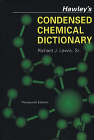 Excellent book for practical chemists, researches, and students.
This book provides condensed and current information not only on chemistry
related subjects, but biology, biochemistry, and many more. It has very good
cross references. I think anybody who decided to buy Hawley's Condensed
Chemical Dictionary would not regret it.

NOTE: No responsibility is assumed by 101science.com for any injury and/or damage to persons or property as a matter of products liability, negligence or otherwise, or from any use or operation of any methods, products, instructions or ideas contained in the material herein. It is the users responsibility to ensure that all procedures are carried out according to appropriate Health and Safety requirements.
NEW!
SPECTROSCOPY
LINKS
SEARCH
THIS SITE
GOTO
CHEMISTRY PAGE 1
GOTO CHEMISTRY LINKS I
GOTO
CHEMISTRY LINKS II
MORE ON OUR
CHEMISTRY PAGE 3

